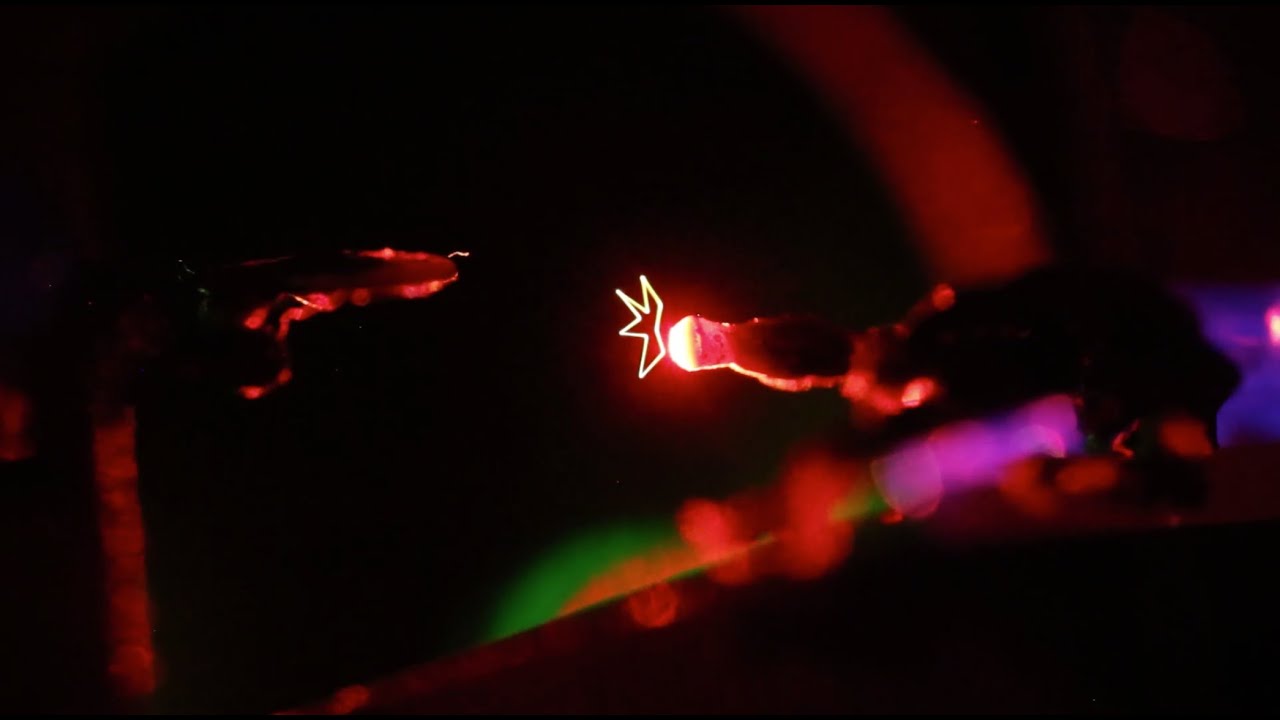
If you thought bagging one of the best graphics cards was difficult, questing for a Kyber crystal is totally unthinkable. But fear not. Where previously, such a pursuit would require you to evidence immense Jedi skills through a series of ridiculous tests, researchers are now one step closer to manufacturing real-life lightsabers with the dawn of particle suspending, holographic technology.
Ok, so currently they have only teeny weeny lightsaber examples to show, and they can't slice through anything… yet. But something quite stunning has been achieved here, so bare with me.
Dan Smalley, a professor of electrical engineering at Brigham Young University, is heading one of the most exciting holographic research projects of our age. Funded by a National Science Foundation CAREER grant, his team have birthed 'optical trap technology.' It gives researchers the ability to trap tiny particles in the air with a laser beam, and by dragging the particle around just fast enough, an image can be drawn in the air (via Pys.org).


It's sort of like when you try to write your name with a sparkler, but a thousand times faster, and way cooler.
This isn't completely new technology either, but a new twist on what the team had already achieved three years prior. Back then, it was possible to draw free-floating objects in space with light, though it was necessary to take long exposure pictures in order to capture the final image, as they were rastered out slowly in physical space.
Best gaming monitor: pixel-perfect panels for your PC
Best high refresh rate monitor: screaming quick screens
Best 4K monitor for gaming: when only high-res will do
Best 4K TV for gaming: big-screen 4K PC gaming
Now though, real time animations have been achieved, and they can actually interact with 3D objects. The results are light-based stick figures walking on human fingers, and photon torpedo animations crashing against tiny model starships. All of which can be seen with the naked eye—no CGI or space-age goggles necessary.
And without the need for a screen, this research surpasses current holographic techniques. As graduate student researcher Wesley Rogers explains, by using motion parallax tricks that involve tracking and adjusting the image as the viewer moves around the display, they can "create the illusion of a much deeper display. Up to, theoretically, an infinite sized display."
Just imagine the possibilities.