


Computex 2026 Live: The biggest PC gaming hardware announcements at this year's show
It's here, it's happening, and we're on the ground covering all the latest hardware news.

Hello and welcome to our Computex 2026 live blog! You'll find all the latest PC gaming announcements from this year's show on this very page. Bear with me a second, because there's a whole lot to cover, so let's get you caught up...
Nvidia RTX Spark
The biggest news so far is Nvidia's announcement of the RTX Spark SoC, which makes use of an Arm-based N1X "superchip" with up to 20 Grace CPU cores and 6188 RTX Blackwell GPU cores.
Nvidia CEO Jensen Huang took to the stage to hold up two RTX Spark-equipped laptops running games, as the GPU core count is equivalent to an RTX 5070. In terms of gaming performance, though, it might be better to think of it as "RTX 5070-like", as emulation may well take its toll on the frame rate depending on the game/implementation.

We'll have to play with one ourselves to find out, of course, but the new SoC won't just be for laptops. There are also said to be Spark-equipped mini PCs and desktops on the way, which marks something of a brave new frontier for Nvidia in the hardware space.
Still, it's the laptop potential that really has us excited here at PC Gamer Towers. Particularly if Nvidia's claims of gaming battery life "better than anything you've seen before on RTX laptops" hold up in practice.
Many questions remain, though. For a start, these systems can support up to 128 GB of RAM, which will be mighty expensive in these RAMpocalypse-influenced times. Will we see reasonably-priced 16 GB or 32 GB offerings? And will the emulation prove to be an issue, or will Nvidia's technical know-how smooth over some of the rougher Arm-based waters, especially as it's working with devs to create Arm-native games?
It's all still to play for. Still, a brand new Nvidia hardware release, with actual gaming potential rather than pure AI chops? Yep, you should pay attention to this one very closely—especially as it gives us a better idea of when to expect next-gen RTX GPUs.
Intel Arc G-Series Panther Lake handheld chips
Let's not forget we had one of the biggest announcements of this year's show... err, last week. Well, sort of. Intel's Arc G-Series chips for handheld gaming PCs have been long teased, but the blue team took the official wraps off well in advance of the show. Hey, getting in first counts for something, I guess?
Two chips were announced, the Intel Arc G3 and the Intel Arc G3 Extreme. They feature "up to Intel Arc B390 graphics", two P-cores, eight E-cores, and four LPE cores. That's a pretty good combination on paper for a handheld chip, particularly as Intel's Panther Lake laptop chips have already proven their gaming prowess.

Our Dave has already got his hands on the MSI Claw 8 EX AI+, one of the first handhelds to use the G3 Extreme, and I think it's fair to say he's rather impressed:
"The device in my hands feels like the standard all new handheld gaming PCs will be judged by"
Dave loves a handheld and he's tested the very best around, so that headline's got me all sorts of curious to test one for myself. The bad news? The price has been mooted as around $1,500.
Sigh. I loved my time with the previous MSI Claw 8 AI+ A2VM, and this new model should make mincemeat of its impressive-for-the-time performance figures. A grand and a half, though? That's some serious moolah, and the same sort of money as some mid-range gaming laptop deals. We thought the Asus ROG Xbox Ally X was expensive, but this? It's proper money, so it'd better be proper good.
Still, if those first impressions hold up, we could be looking at the new king of our best handheld gaming PC guide. That being said, it looks like there'll be plenty of handhelds featuring the chip at this year's show, so the MSI beastie has some competition straight out the gate. Stay tuned here to see what we make of the rest, as the show goes on.
And now for something completely different...
Would you like a holographic dragon in an over-sized test tube mounted to the front of your gaming PC?
No, I'm not sure either. But MSI has unveiled the MEG Vision X2 AI with a "first-of-it's kind AI Holostage", featuring the company's mascot, Lucky the dragon, as an AI avatar.

Yep, it's not subtle. Still, the press release suggests that a choice of digital companions will be available in future, and the "LuckyClaw" avatar will be available to respond to natural speech commands to help you tune your rig.
I'm really not sure how to feel about AI cyber prisons attached to the front of our machines (or on our desks), but perhaps we're looking at the future. Or, an experiment that makes for a booth-friendly showcase of MSI's burgeoning AI tech.
Still, Computex is known for wild PC case designs, and this one's certainly that.
Hey look, an AMD graphics card
While proper next-gen graphics cards are a ways off yet, there's still some new GPU news in the form of the RX 9070 GRE. The previously-China-only card will now be available to the rest of the world with an MSRP of $549. That's the same original price as the RX 9070, but graphics card pricing being what it is, it's soared ever higher since launch.

The RX 9070 GRE has 48 compute units, as opposed to the 56 in the RX 9070 proper, and slightly lower ray accelerator and AI accelerator counts, too. Still, it looks beefy enough to provide a decent whack of gaming grunt for a fairly reasonable sum.
Will the RX 9070 GRE prove to be a good value proposition in a crowded graphics card market full of inflated prices? Time to break out the test rig, I guess. Watch this space.
The Ryzen 7 7700X3D looks like my kinda gaming processor, as AM5 sticks around for the long haul
AMD's current-gen CPU socket looks to be sticking with us for some time to come, as the company has extended its AM5 platform commitment until 2029. As Zen 6 processors are expected to appear either later this year or at some point in 2027, it's possible that even Zen 7 chips (if naming schemes hold) will be supported by the current socket.
Speaking of new chips, the red team has also announced a new CPU offering: the $329, AM5-based Ryzen 7 7700X3D. The launch comes alongside the re-release of the Ryzen 7 5800X3D as part of AM4's 10-year anniversary celebrations.
I run a regular Ryzen 7 7700X, and I've often wished it had a dose of 3D V-Cache for some extra gaming performance. Not that it's slow, mind, but some extra stacked cache can be pretty magic stuff for gaming. I'll be putting my hand firmly up to test one of those, don't you worry.

AMD has also announced an upcoming upgrade to its EXPO memory overclocking system, EXPO ULL. That's EXPO Ultra Low Latency to give it its full title, which the company claims can delivery an "additional 4% FPS (on avg) vs non-ULL EXPO memory."
Which, as our Nick points out in the article above, is probably pretty resolution and graphics settings specific, as DRAM speed isn't usually the biggest bottleneck in gaming systems. Hey, upgrades are upgrades—and AM5 looks to be in it for the long haul.
Booo, no hairy fan—but this thermal pad has some seriously cool tech
All of us on the PC Gamer hardware team were left scratching our heads last week, after Noctua teased an image that looked suspiciously like it was launching a hairy fan.
But alas, it turns out it's just the NT-CP1 AM5/4 carbon nanotube CPU cooling pad. Actually, what am I talking about, that's pretty freaking sweet. And get this—Noctua and Carbice (the former is exclusively distributing the latter's thermal pad offerings) say it actually improves in thermal performance as time goes on.

"While thermal pastes and most other thermal pads gradually lose performance over time due to pump-out, delamination, cracking, and other degradation, the performance of Carbice pads continues to improve over hundreds and thousands of thermal cycles," says the press release.
Awesome. I mean, not as awesome as a brushy fan in your PC, but still. Anything carbon nanotube-based gets instant cool points. See what I did there?
Frame generation? Nah, frame extrapolation is where it's at, according to Intel's Tom Petersen
Our Dave has been chatting to Intel's Tom Peterson about latency, frame generation, and the future of the tech in relation to Intel's G3 handheld chips. It's a super interesting read, so I'd highly advise you to check out the article right here:
Extrapolation is the future of frame generation without the latency hit… and it's not far off

As a teaser, though, allow me to quote from Peterson:
"So the first frame has just been sitting around waiting for this entire process to happen, and now we're ready to show you four frames. So that's where the latency you feel is coming from.
"With extrapolation, we don't do that. With extrapolation, we get the first frame and we show it to you, and then instead of waiting for the second frame, we're using AI to predict where we think you're going to be."
Coming soon? Perhaps. Even more controversial than current frame gen tech? Also perhaps. Still, it's certainly piqued my interest.
In other Nvidia news, DLSS 4.5 Ray Reconstruction looks pretty sweet actually
Amid all the hubbub surrounding the Nvidia RTX Spark, you may have missed the announcement of DLSS 4.5 Ray Reconstruction. No longer will your rays be reconstructed by a CNN model, as an update will bring a 2nd generation transformer model to the party in August—bringing it in parity with DLSS 4.5 itself.
What that means in practice, according to Nvidia, is much better denoising and far superior image quality. The new model processes 20% more parameters while "maintaining similar performance" to the previous model, apparently.

It's also got better spatial awareness, and uses motion data and game engine pixel sampling "more intelligently" to create a better visual result than previous versions, so says the press release.
I've sometimes limited ray tracing options in supported games because the noisy lighting/temporal shifting has been a distraction, so any improvements in this regard are most welcome. I know it's not the biggest Nvidia news of the show so far, but it's worth a look if you're planning on pushing your games to their maximum in the near future.
This Asus ROG Astral RTX 5090 is an absolute chungus
It wouldn't be Computex with some seriously over-sized graphics cards, and Asus has outdone itself already this year. The Asus ROG Astral GeForce RTX 5090 Edition 20 looks like an absolute cinderblock of a GPU, and you know what? I'm into it.

Not only is this graphics card absolutely massive, but it's got an AMOLED display wrapped around the back corner to... well, do whatever screens do inside your PC. Look pretty, mostly.
Still, buying an RTX 5090 these days (especially a special edition model) is all about excess, and in this case, I think Asus might have made something rather unique. I dig the retro-industrial detailing, the gold accents, and the beefy fan. Hell, I'll probably dig the performance, too—but the price is likely to be similarly outrageous.
Ah, it's not a graphics card for the likes of me, I know. Still, a hardware writer can dream, can't they?
A golden mouse of significant heft
Asus has festooned one of its gaming mice with "authentic 24K gold-plated detailing" as part of the ROG brand's 20th anniversary celebrations, so we'd better add it to the growing list of PC products coated in the shiny stuff.
Okay, so it's not the Asus ROG Astral GeForce RTX 5090 Dhahab OC Edition. Still, it seems gooooooooold might be one of the early themes to look out for at this year's show, alongside the word "expensive." What a time to be alive.

The ROG Harpe II Extreme Edition 20 weighs 82 g, has an 8,000 Hz polling rate and a 65K DPI sensor, and is rumoured to cost $260. Hey, I don't mind a heavier gaming mouse—and the specs sheet is pretty impressive. It's a bit of a looker, too. Anyone got any spare change?
Want a spinning gaming chair keycap? Of course you do
Asus really seems to be going all-out for its ROG 20th anniversary celebrations. Beyond the mega RTX 5090 and the gold-festooned mouse below, it's also announced some of the most peculiar keycaps we've ever seen as part of a mystery box package.

Being mystery boxes, I suppose there's no guarantee you'll get the keycaps themselves, which is a shame. As bizarre as the designs are, I'd love a set for sheer curiosity value. Especially as one of them is a spinning gaming chair.
I reckon the collectible value is pretty high for one of those, don't you? Anyway, it might be the most unusual Computex 2026 release I've seen to date, although watch this space. I get the feeling today's going to be a weird one.
Noctua's pumpless liquid cooler seems to be coming on leaps and bounds
Every time I see an iteration of Noctua's pumpless thermosiphon liquid cooler, I have to think long and hard about how heat works and how badly my science education failed me.
The good news, though, is that our Jacob has been chatting to the good folks at the Noctua booth, and its latest prototype can now apparently cool a Ryzen 9 9950X3D about as well as a traditional AIO.

Check out the article linked above for the full deets, and join me in being thoroughly impressed. Who needs pumps, anyway?
Gigabyte's new mobo 'combines space-tech and data center-grade design through rocket thruster-grade thermal materials.' Gosh.
I've got a penchant for the overbuilt, and Gigabyte's X870E Aorus Infinity Next motherboard looks to be just that. According to the press release, it's got "flagship engineering" that "combines space-tech and data center-grade design through rocket thruster-grade thermal materials and advanced 3D metal printing technology."

It's also got 64 power phases, which seems a touch... excessive? Still, as a celebration of the company's 40th anniversary, it's certainly a pretty thing. I've suddenly made this shallow, haven't I?
MSI is finally ready to release its mega Maestro 900R chassis, but you'd better get saving now
I've stood in front of this MSI mega case at CES earlier this year, and can confirm it's very impressive. The company now says it'll be releasing in Q3 of this year, and it'll also be... rather expensive. As if we thought anything otherwise.

To be fair, it's the sort of case you'd buy for a money-no-object mega rig, although our Dave has spotted the odd design detail that has given him pause. Still, $699? Holy moly. One for the well-heeled ultra enthusiasts, it seems.
Heyo, it's the 'world's first holographic liquid cooler'
It wouldn't be a tech show these days without many, many screens attached to coolers, but Tryx has gone one better this year and made one with a hologram. Well, something with a "a slight holographic appearance to it" says our Jacob, as he's been standing in front of it squinting.

It's best viewed straight on, apparently. Still, is this a glimpse of our future? We've had traditional screens inside our PCs, but what about hologram effects? Asus seemed to think so at CES earlier this year, too...
The Corsair Nightsword v2 Wireless has a Stream Deck button, which I definitely won't fat finger in the heat of battle
Our James is a big fan of his Stream Deck, which means he's also very interested in the newly-announced Corsair Nightsword v2 Wireless. It's got a dedicated button that brings up a Stream Deck overlay menu with all sorts of control options.

Me? I know I'd accidentally press it at a crucial moment. Still, we've seen gaming mice with touchscreens on the side, and that's a much worse idea. This one? The jury is out, but it's an intriguing rodent at the very least.
The RTX Spark is '100% awesome at everything everybody expects the PC to do,' according to Jensen
Our Dave has attended a Q&A session with Nvidia CEO Jensen Huang, and the leather-jacketed one was keen to talk up the benefits of the new RTX Spark SoC. Check out the story here, and also this photo of yet another impressive piece of outerwear:

MSI has a next-gen GPU cooler concept on display, and it's got lots of esoteric specs
Those of you hoping for next-gen graphics cards at this year's show will have to make do with this next-gen graphics card cooler instead. But wait, MSI's concept is actually pretty intriguing!

Metal fan blades? Rifled heatpipes? Diamond-composite thermal pads? Yep, the future of GPU cooling sure has some unusual hardware, if this example is anything to go by.
Something genuinely affordable at Computex? Mercy me.
In among the gold-festooned gaming mice and the hugely-overbuilt motherboards, I've been hunting for something genuinely affordable in this year's coverage. And lo and behold, our Nick/Jacob combo has found this—a new Arctic air cooler starting at $58.

Sure, it's not the flashiest of components (although there is an RGB-lit version), but a good CPU cooler can make a massive difference to the performance of your PC. I personally like an all-black design, and this one has rugged vibes that I genuinely dig. Well played, Arctic. Well played indeed.
The skinniest of keebs
Our Dave says this Keychron carbon fiber keeb prototype (what a sequence of words) feels so skinny and light, it's barely there. It's potentially one of the world's thinnest—and while it doesn't have a name yet, we should see something similar on sale at some point around the end of the year.

Cool. Shove a review sample through my letterbox, would you?
All hail the Hello Kitty PC
In among all the edgy RGB-lit cases of Computex 2026, it's nice to see something refreshing. Like these DarkFlash Sanrio offerings, with loveable mascots PomPomPurin, Kuromi, Cinnamoroll, and Hello Kitty emblazoned on the outsides.

I hope I got all that right, as I know nothing of such whimsy. I'm far too miserable to run this sort of case design, but those of you with a taste for the colourful and the cute will hopefully get a kick out of it.
Back to my edgelord cave. It's dark in here, and I'm brooding. No mum, I don't want any dinner. Shut the door on the way out, would you?
Is it a briefcase? Is it an air conditioning unit? No, it's a PC case. We're pretty sure, anyway.
For the more utilitarian-minded, how about this head-scratcher of a PC case? It's called the Tryx Vas, it's at Computex, and we don't know much about it.

We sort of want one, though. On that we can all agree.
The Logitech SuperStrike's switches have some new competition in town
The Logitech G Pro X2 SuperStrike is a very, very impressive mouse as far as we're concerned. That's mostly down to its Haptic Inductive Trigger System switches, which seem to be a love it or hate it affair in terms of tactile response. Our Jacob Fox loves them. Others aren't so sure when it comes to the feel.
However, our Dave has got his hands on Keychron's new optical/Hall effect models—and they look to be addressing some of the feedback around Logitech's offerings.
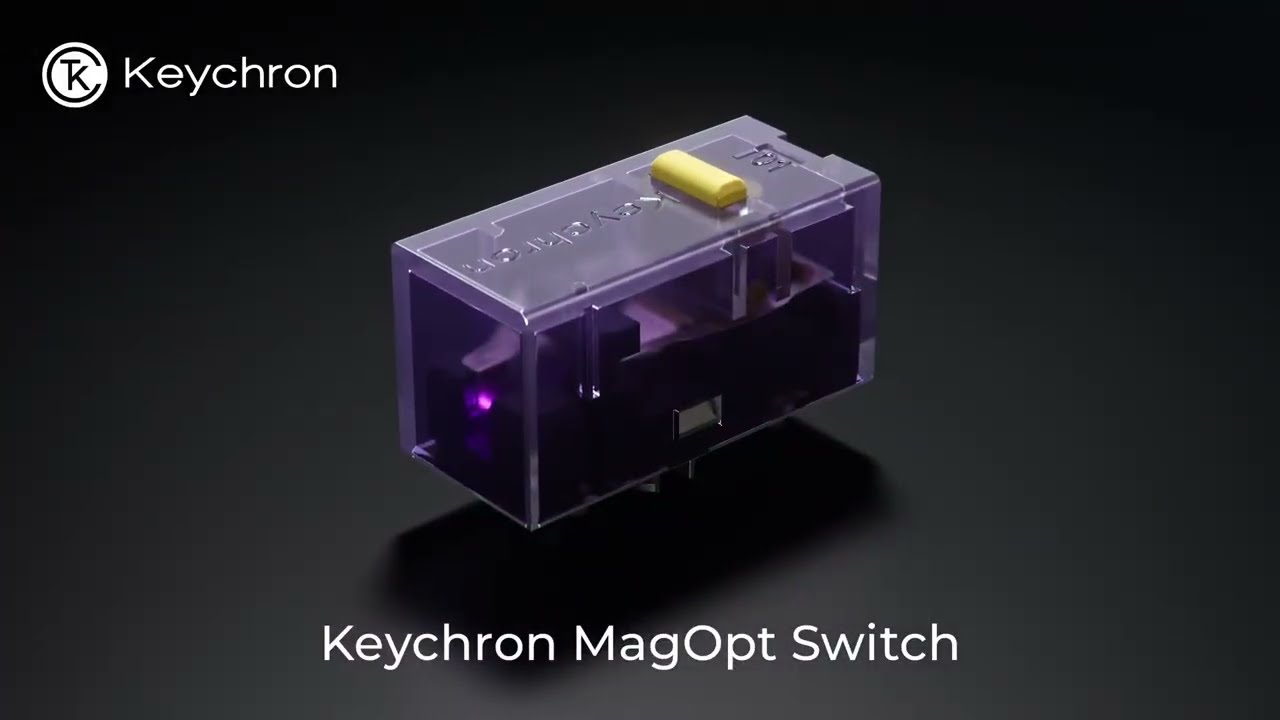
One type of switch is clicky, the other has a tactile bump, and another is completely linear. "We combine this with a haptic engine—you know, just a vibrator—inside the mouse, then it's just same trick," says Keychron CEO Nick Xu.
The switches should be appearing in Keychron mice very soon. Hey, competition is a good thing, right? For us consumers, at the very least.
Does this 3000 W PSU for gaming PCs make any sense?
Excess is certainly one of the running themes of Computex, and this year's show has been no exception. In among the offerings exists this Asus ROG Thor 3000 W Titanium III Edition 20, and our Nick's really not sure about it.
It's impressive, of course. And it's even got an OLED display that can be magnetically attached to the PSU or your PC's case with an extension cable. But four 12V-2x6 power sockets? Asus knows that multiple graphics cards for gaming isn't really a thing anymore, right?

Anyway, it's part of Asus' ROG anniversary offerings, so it's more of a show piece than a product you're likely to go running out and buy. We salute the tech, and the impressive name. As for the practicality of such a mega PSU under the ROG gaming brand? Eh, pass.
RTX Spark handhelds? Not any time soon, by the sounds of it
Nvidia CEO Jensen Huang was asked about the potential of an RTX Spark SoC crammed into a gaming handheld, and had this to say:
"If somebody wants to do it, you know, we'll work with them on it. But right now we're really focused on doing something that is just such a big deal, reinventing the PC after 40 years."

So, nothing in the works then, by the sounds of it. At least from Nvidia's perspective. Hey, we can still dream, right?
Wooting's big knob is back
Low-hanging fruit, I know. Anyway, Wooting announced the development of a knob for its 80 HE gaming keyboard at last year's show, and it's now reappeared at Computex 2026 as the Lekker Knob large.

Look, I didn't name it. Anyway, our Jacob has got his hands on one, and it's impressive. Far more than simple volume dial, the knob can be programmed in the Wootility app for a wide array of functions—and the company has even been experimenting with the idea of using it as a steering wheel input in a racing game.
It's just an idea, of course, but it goes to show the flexibility on offer here. Also, I'm finishing off this post before I make any more ill-advised jokes. I think I got away with it, but we'll see. If this blog goes dark, you know what happened. It's been a pleasure writing for you.
Cor, look at the size of this Cooler Master fan

This, my friends, is Cooler Master's Mighty40 220 mm fan. You get two of them in the front of the company's new HAF II 500 PC case, and they look like they could move enough air to cause a small weather event. Nice.
Jacob has been giving the new Cooler Master offerings a thorough going over at its Computex 2026 booth, and I'm liking a lot of what I see. There are even some golden offerings, which tap into one of the running themes of this year's show rather nicely. Golden graphics cards are one thing, but golden air-movers? Now we're talking.
One of Gigabyte's new keebs has a triple-split spacebar
The oracle that is Jacob Ridley predicted that split spacebar gaming keyboards would become one of the next big trends earlier this year, and lo it has come to pass. Or rather, Gigabyte has launched a triple-split one, alongside a double-split model, a new gaming mouse, and a web version of its GiMate software.

I kinda like the idea, as I sometimes struggle to bind all my tactical shooter inputs across the regular keys, while my spacebar only really has one job. It's not a new concept, of course, but will we see more of these as we hunt down the booth offerings?
My money's on yes. Alas, I am no great sage. But Ridley? He knows a thing or two, trust me.
Stop the presses, it's a samurai sword PC
Well, we can all go home. Corsair has a gaming PC with a wieldable RGB samurai sword at its Computex booth, which means the show's over, folks. Nothing's going to top this.
サムライ・ソード・コンピュータ pic.twitter.com/ZvXHCAP3P8June 3, 2026
I'm kidding, of course. Still, this is the most outlandish case design we've seen yet, particularly as the sword's hilt spins to show off the company's limited edition Shugo DDR5 sticks.
Will the case ever be sold? My money's on no. Still, the famous Cooler Master Shark eventually made it to market, so nothing's impossible.
Do I want one? Yes. Where will I put it? I literally have no idea. Let's not let practicality get in the way of a good time, though, shall we?
'Oh, my goodness. This is one of the best. This changed everything': Jensen loves the GTX 1080 Ti
Nvidia CEO Jensen Huang was asked to sign a GTX 1080 Ti yesterday, and reacted with genuine enthusiasm. I wonder how long it's been since he last saw one?
A mina conseguiu um autógrafo do Jensen Huang, fundador e CEO da NVIDIA, na sua placa GTX 1080 TI Founders Edition.Será que agora ela vale uma grana num leilão? pic.twitter.com/yiv91vj0V4June 2, 2026
Well, it is one of the best graphics cards of all time, I'd say. Fondly remembered, and still running in the rigs of some gamers today. Lovely stuff.
Corsair's made an affordable gaming chair that ditches the gamer flair for something a little more grown up
Corsair's new TC80 is a comfortable-looking thing, and it's already got some admirers here at PC Gamer Towers. We haven't sat on one yet, but an affordable gaming chair with a subtle, refined design? Sounds promising to us.

It's described as "coming in at an accessible price," so it'll be interesting to see what the final MSRP ends up being. Still, it's nice to see something with an eye on value in amid all the expensive stuff.
Who had 'removable PSU cable dock module' on their Computex 2026 bingo card? Anyone?
Here's an interesting thing: Thermaltake's Dockpower series of PSUs have a removable plate for the cable connections. The idea being, you fit the cables into the dock plate, and then attach the plate wholesale to the installed power supply.

In practice, this could potentially mean a PSU upgrade without swapping all the cables around individually. I'm not entirely convinced on the utility, but it's an intriguing idea at the very least.
Biwin's got a very fast 256 GB DDR5 memory kit at its show booth. Yes, it's expensive. How did you guess?
Biwin's top of the range 256 GB dual-channel DDR5-8000 CL42 CQDIMM kit has caught the eye of our roving reporters, as it's a bit of a looker—and is of course, very fast and hugely capacious.

It'll also cost somewhere between $2,500 and $3,000. Dang it. Bang goes my Christmas gift list.
If there's one thing that makes us happy, it's a Venom-like, ferrofluid-filled doohickey on a PC case
Amiiba's new Ferra microATX PC case has captured the hearts and minds of us all here at PC Gamer. It's got a little tank mounted to the front filled with ferrofluid, which reacts to magnets and sound, thanks to a microphone around the back.
The case itself has removable face plates, and comes in at $199 for the ferrofluid-filled version. Or $119 without, but I mean, come on. Why wouldn't you go for the Venom vibes?
Yo dawg, we heard you like PCs, so we... eh, you know the rest
Two PCs, one case. That's the concept behind Thermaltake's Capo X PC case, which crams two Micro ATX systems into a single chassis. It's a bit tall, of course, but otherwise the footprint is fairly minimal.

Who would want such a thing, I hear you ask. Well, if you happen to share a gaming space with your partner, you could put both your PCs into one case to save on desk space. Or if you're a streamer, you could have both a gaming and a streaming rig in a single chassis.
Or, you could use it for two AI-crunching PCs. That'd be really dull though, wouldn't it? Let's keep things gaming-focused around here folks. As best we can, anyway.
Corsair's wooden Frame 5000D front panel is making my eyes go funny. No wait, that's the caffeine

I've stared at this image for so long now, the edges of my monitor are beginning to warp. It's one of two new wooden front panel designs for Corsair's Frame 5000D case, and it's twisting my melon, man.
Apparently, the case panels are supposed to "blend in with your office or gaming den’s décor." This one, though? Only if you game in a carnival funhouse.
I reckon if you panelled a wall with a bunch of these, you could make the family cat stick to the ceiling. It's been a long day, folks. Can you tell?
We've played several demanding games on an Nvidia RTX Spark laptop and it's looking pretty peachy
For those of you wondering how demanding games might run on an Nvidia RTX Spark laptop, our Dave has been playing an Arm-native build of Alan Wake 2. And by the looks of it, it's a very smooth experience.
Dave wasn't allowed to go hunting through the settings menu, and it's unclear just how much frame generation was involved. Still, so far? He seems pretty impressed.
AW2 wasn't the only game on offer, as he also got a chance to play emulated versions of Indiana Jones and the Great Circle and Pragmata. Check out his hands on gameplay impressions with RTX Spark to see how Nvidia's hardware might handle some very demanding—and very pretty—games.
Cooler Master's prototype mega-AIO can potentially handle up to 2000 W of thermal capacity
Cooling, cooling everywhere is a usual theme of Computex—but this year, Cooler Master looks to have kept one of the more intriguing solutions back at base. Jacob has been for a nose around the company's Taiwan HQ, and found a mega AIO with four 180 mm fans, a massive radiator, and potentially, 2000 W of thermal capacity.

It's just a prototype/mockup for now, by the looks of things. It seems likely to come for workstation PCs, but will we eventually see massive fan arrays strapped to the side of our gaming PCs? Perhaps.
Framework's 'MacBook Pro for Linux users' looks seriously impressive
The Framework 13 Pro has had Dave very excited since its announcement earlier this year, and he's now had a chance to get hands on with one at Computex. We haven't been able to give it a proper testing yet, but his first impressions of the new Framework laptop are very promising indeed.

A sturdy anodised aluminium chassis means the new Framework feels very much like a MacBook or Razer Blade, and they're about about as premium as laptop designs get . I'll leave the rest to Dave in the article above, but this one seems like a real winner.
The re-release of the Ryzen 7 5800X3D was a lot more involved than you might think, according to AMD
You might have assumed (as did I) that bringing back the Ryzen 7 5800X3D was a matter of spinning up the old manufacturing process, but according to AMD's David McAfee, it was a lot more involved than that.

"We had to kind of re-engineer, re-qualify, and rebuild that product in a way," says McAfee, "so that it could migrate from that old process that really wasn't around anymore to the newer process."
The more you know!
AI is why we can't have nice things. Also, Arc B370 iGPU-ed chips in our devices
The Intel Arc B390 is an impressive iGPU, there's no doubt. However, when the Panther Lake lineup was announced, we were eyeing up chips with the 10 Xe3-core Arc B370 as a potentially more affordable sweet spot.

We want it in a laptop, and we're curious about it in the (non-Extreme) Intel Arc G3 handheld chip. However, Dave has been talking to various Intel folks and laptop/handheld manufacturers, and there looks to be a reason why it's mostly MIA.
Can you guess?
It's the little things: Corsair's new case has a light above the rear I/O panel
We've mentioned Corsair's new Warthog case already, but Jacob has inspected one for himself and found some lovely little details. My favourite is the existence of a small light about the rear I/O panel, which can be activated with a switch on the front.

I have a separate bendy USB light next to my PC for this exact purpose. Well, and a bit of ambience. But integrating such a feature into the chassis design is a very cool move, as hunting around for the right port on the back of your gaming rig is definitely a pain point, especially in the dark.
The more I see of this case, the more I like it. The theming might be a little OTT, but I'm really starting to get on board with what Corsair has cooked up.
Galax has a next-gen GPU design concept with Swarovski crystals in it
Galax's vision of the future features Swarovski crystals on a next-generation GPU cooler, which is probably a sign of the times.
HOF新デザインはスワロフスキー付きらしいwwwww https://t.co/bxgr6XpZtC pic.twitter.com/hp87mu8sHHJune 3, 2026
To be fair, it's a concept for its Hall of Fame range, which are always a bit over the top. Still, shiny, "look at me" materials are a bigger theme than usual this year, huh?
This case has a screen. Or this screen has a case. One of the two.
In my ongoing battle against screens inside gaming PCs, I often feel like I'm losing the war. Gigabyte has just struck back with a 165 Hz 16-inch panel inside a microATX case window, and I feel the life inside of me slipping away.

Actually, this screen's of such a size, it might actually be useful. And it's more of a market research exercise than an actual product at this point, as Gigabyte is gauging the reactions of show attendees.
Me? I'm not a huge fan, quelle surprise. But hey, if we all liked the same thing, life would be pretty boring, wouldn't it?
Everyone loves a diorama PC build, right?

Fancy some Taiwanese sausage with sticky rice? Well, you'd better bring your tiny wallet, as there's a night market scene built into the side (and front) of this gaming PC build. Oh, and the Taipei 101 skyscraper, of course. Extra onions, please.
The Corsair Warthog is my pick for 'thing I'd actually want to take home from Computex 2026'

I know you've all been waiting with bated breath, and the show isn't technically over yet, but I've made my decision. The Corsair Warthog is the thing that my heart desires most from Computex 2026. Unless we get surprise new graphics cards at the last minute for some unknown reason. Which we won't. Probably?
As a treat, how about some more photos of that Corsair samurai sword gaming PC?


We liked the Corsair samurai sword gaming PC so much, we tasked our most potent weapon, Jacob Ridley, with taking some more photos of it. Emerging from his cocoon like some sort of caffeine-addled superhero, he charged across the show floor and came back with these. Enjoy.
Our James has found one MSI laptop he likes the look of, and one he really doesn't

Hey, taste is a subjective thing. And MSI has managed to split the opinion of our James Bentley, who loves the look of its Vincent Van Gogh-themed laptop offering, and not so much the one with a big dragon on the lid.
Nothing against dragons, of course. It's just a bit much when you take your laptop out into the big wide world, isn't it?
We've had Swarovski crystals this Computex, but how about diamonds?
Our Jacob has been touring Thermal Grizzly's show booth, and he's found an experimental cooling project with a difference. That difference being, diamond sheets.

Yep, the exotic materials continue to roll out this Computex, although in this case, they're there to serve a genuine purpose. The industrial diamond sheets are carefully positioned to make contact with a CPU's CCDs, providing better thermal conductivity than traditional copper.
Much better thermal conductivity, as it turns out. The project is, however, "experimental as heck," reports Jacob. Still, cooling boundaries really are being pushed this year. Stay chilled, folks.
Heyo, AIO. This one's got a fan built into the CPU block, as 'kind of a hybrid'
Cooler Master has certainly brought a lot of interesting products to this year's show, and Nick is rather taken with this concept AIO cooler that "looks like it could chill Venus into Pluto."

The extra aluminium fan on top of the block looks to be a well-integrated bit of engineering—and unlike other fan-on-block systems we've seen, it's not designed to cool just the VRMs, but the actual water in the loop itself.
Far from being belt and braces, this is something we'd love to see make it beyond the mock-up phase. Nick's got his wallet ready, put it that way.
There's some g-g-ghostly RGB lighting emitting from this translucent Hyte cooler
As if appearing through the mist, we've spotted this Hyte AIO prototype at the company's Computex booth. The radiator is transparent, the CPU block is translucent, and it's casting foggy RGB vibes around the halls as the show draws itself to a close.

We don't know a whole lot about this cooler, but we do know the RGB lighting on the pump cap spins around. Which is more "70s disco" now I think about it, but hey man, I'm groovy. Get down, etc etc.
You can use this MSI keeb underwater and it'll still record your keystrokes. Y'know, if you want to.
MSI's Strike Alloy TMR keyboard is waterproof. We know this, because YouTube channel We Do Tech has filmed themselves dunking it into a display tank, demonstrating how the keeb still functions when mostly submerged. Cool.

It's also got TMR switches, 8K polling, rapid trigger support, and a separate touch screen side panel. Not only has MSI thrown the kitchen sink at this keeb, but it's thrown the keeb in the kitchen sink. That was better in my head, I promise.
